The Impossible Made Possible: Minecraft Runs on Sega Saturn
- Android: 8,0+🕣 Updated
- CategoryInstructions
![The Impossible Made Possible: Minecraft Runs on Sega Saturn]()

In the world of video games, there’s an unwritten rule: if a device has a screen and a processor, someone will try to run Doom on it. However, in recent years, this challenge has evolved. Now, the ultimate "survivability" test for hardware is Minecraft.
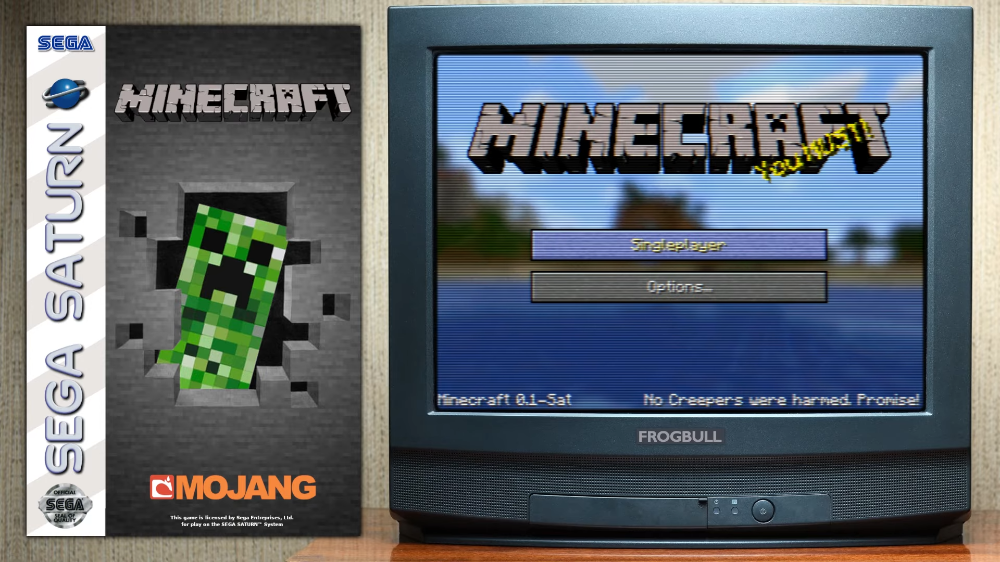
It seemed like we had seen this blocky sandbox everywhere — from high-end PCs to smartwatches. But a recent piece of news truly shook the retro community. A talented enthusiast and developer known as Frogbull achieved what many deemed technically impossible: he successfully ported and ran Minecraft on the classic Sega Saturn console, released in the mid-90s.
Why port a modern game to 30-year-old hardware?
For many gamers, the Sega Saturn remains one of the most underrated consoles of the fifth generation. Despite its rich library, it is notoriously known for its complex architecture, which was a nightmare for many official developers at the time.
Frogbull’s project is not just an attempt to play "blocks" on an old TV. It’s a challenge to engineering ingenuity and a test of the limits of retro hardware. The main motivation behind such projects lies in pure technical curiosity and love for the platform. It’s an attempt to answer the question: "What if Minecraft had been released in 1994?"
Technical Challenges and Adaptation Process

Porting a game based on voxels and procedural generation to a console designed for 2D sprites and primitive 3D — is a monumental task. The Sega Saturn uses a unique architecture with two central processors and a complex video chip system that operates with quadrilaterals (quads) instead of the triangles common in modern 3D.
To accomplish the port, the developer had to solve several fundamental problems:
- Memory Optimization: The console has an extremely limited amount of RAM compared to modern standards (just a few megabytes). This required strict code optimization and reduced draw distances.
- World Rendering: Frogbull had to adapt the game engine to the specifics of the Saturn’s VDP1 video chip, forcing it to process 3D voxel landscapes in ways not intended by the console’s creators.
- Controls: Adapting the controls to the Saturn gamepad, which lacks a second analog stick (in its standard version), was also an interesting interface design challenge.
The result is a fully playable version that, while inferior to the original in resolution and frame rate, retains the recognizable mechanics of building and breaking blocks.
Impact on the Community and the Future of Homebrew
Frogbull’s success — is a powerful message to the entire community of retro gaming enthusiasts and homebrew developers. This project proves that the potential of old consoles is still far from fully explored.
Such achievements play an important role in preserving gaming history. They draw new audiences to classic platforms, showing that the Sega Saturn — is not just a museum piece but a living platform capable of surprising even three decades later. Working on such ports often leads to the creation of new development tools and libraries, which are then used by other enthusiasts to create new indie games on old hardware.
Conclusion
Running Minecraft on the Sega Saturn — is more than just a fun experiment. It’s a tribute to the engineering genius of the past and a demonstration that the passion of fans knows no bounds. Frogbull showed us that, with enough effort and technical knowledge, the limits of what’s possible can be pushed even on hardware from the last century.
What’s your take on such experiments? Do you see them as a waste of time or an important contribution to the technical culture of gaming? Share your thoughts!
- publishedMceadmin
(Google Ads) Privacy Policy and Terms of Use


