Minecraft Creator Calls DLSS a Pointless Technology: Why the Community Disagrees
- Android: 8,0+🕣 Updated
- CategoryInstructions
![Minecraft Creator Calls DLSS a Pointless Technology: Why the Community Disagrees]()

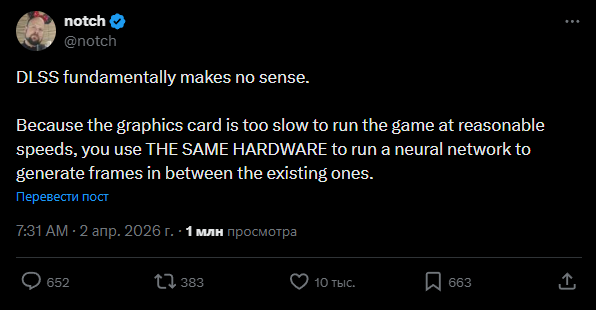
Markus «Notch» Persson, the man who gave us Minecraft, recently sparked heated discussions among gamers. On his X social media account, he harshly criticized NVIDIA's DLSS technology. According to him, this tool fundamentally makes no sense. The statement quickly spread across the internet, prompting active reactions from both regular players and technical experts who rushed to explain the workings of modern graphics processors to the developer.
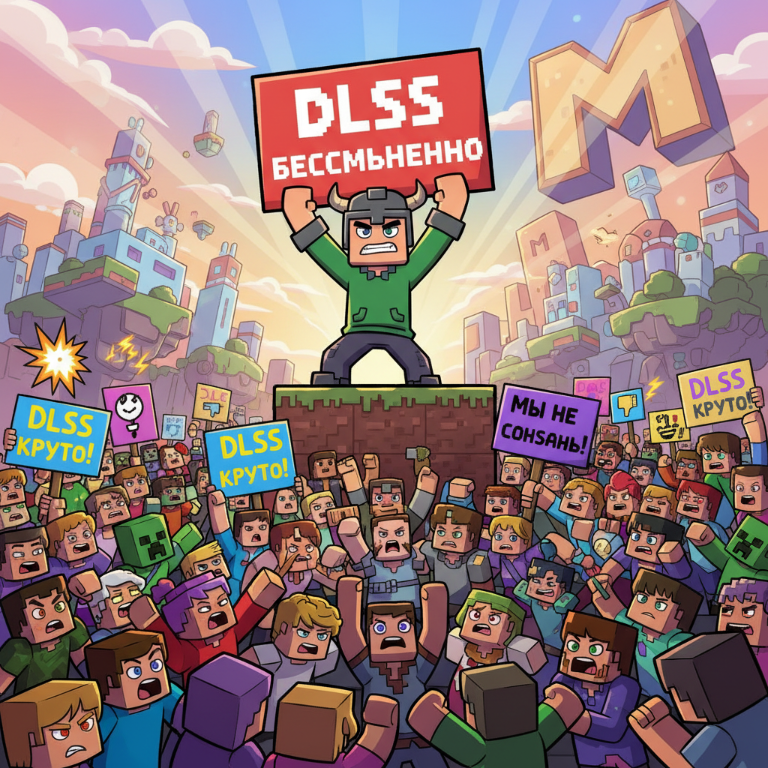
What Are Notch's Complaints?
Notch expressed doubts about the very concept of frame generation, which is a key part of modern DLSS versions. His logic is based on a fairly simple assumption: if a graphics card is not powerful enough to run a game at a good frame rate, why use the same computational power to operate a heavy neural network?
The developer finds it odd to spend GPU resources on generating fake frames instead of using them for direct game rendering. At first glance, this seems logical to many users accustomed to the traditional approach of boosting performance through raw computational power.
The Community's Response: Why the Technology Works Differently
Gamers and experts quickly pointed out a significant flaw in the Minecraft creator's reasoning. A modern graphics card is not a single monolithic chip where all elements perform the same task. DLSS technology uses specialized tensor cores. These hardware blocks are designed exclusively for machine learning and artificial intelligence tasks.
When you enable smart scaling or frame generation, this process does not take resources away from the main GPU cores responsible for geometry construction and lighting calculations. Instead, the tensor cores handle separate tasks to enhance the image. This allows the graphics card to work much more efficiently, delivering smooth visuals without sacrificing overall performance.
Importance for Gamers and the Future of Graphics
The video game industry is constantly evolving, and hardware demands grow every year. The traditional approach, where a graphics card simply renders every pixel in high resolution through brute force, is becoming too costly. Engineers understand that increasing raw performance through conventional methods is becoming increasingly difficult.
This is why AI-based technologies are becoming the new standard. Smart algorithms help us run demanding projects with complex ray tracing even on mid-range graphics cards. Of course, the technology has its drawbacks. On weaker systems, heavy scaling can result in visual artifacts or input lag. However, calling this approach pointless ignores the real progress that saves millions of gamers' wallets.
Time to Draw Conclusions
Persson's statements showed that even experienced developers sometimes overlook important nuances of modern GPU architecture. NVIDIA's approach has proven its practical value, allowing players to enjoy high-quality graphics without needing to purchase the most expensive flagship devices. DLSS does not take power away from the game but instead uses hidden reserves of smart hardware.
We are very interested in hearing your opinion on this situation. Do you think smart scaling and frame generation technologies are a true savior for modern gaming, or do you agree with Notch and prefer to play only at native resolution? Share your thoughts in the comments and join the discussion.
- publishedMceadmin
(Google Ads) Privacy Policy and Terms of Use


![Chicken Gun [Null's]](/uploads/mini/scroll-rel/63/1693986698_icon.png)


