Minecraft Inside Minecraft: The Incredible Redstone Computer That Redefined the Game's Possibilities
- Android: 8,0+🕣 Updated
- CategoryInstructions
![Minecraft Inside Minecraft: The Incredible Redstone Computer That Redefined the Game's Possibilities]()

The world of Minecraft has long ceased to be just a "sandbox" for building castles and surviving. Thanks to redstone mechanics, the game has become a platform for engineering experiments, where enthusiasts create calculators, music players, and even simple processors. However, the community's recent achievement has taken these experiments to an entirely new level. We're talking about the creation of a fully functional redstone-based computer capable of running … Minecraft itself.
Let’s break down how this was made possible, the technical marvels behind this project, and why this event is historic for the entire gaming community.
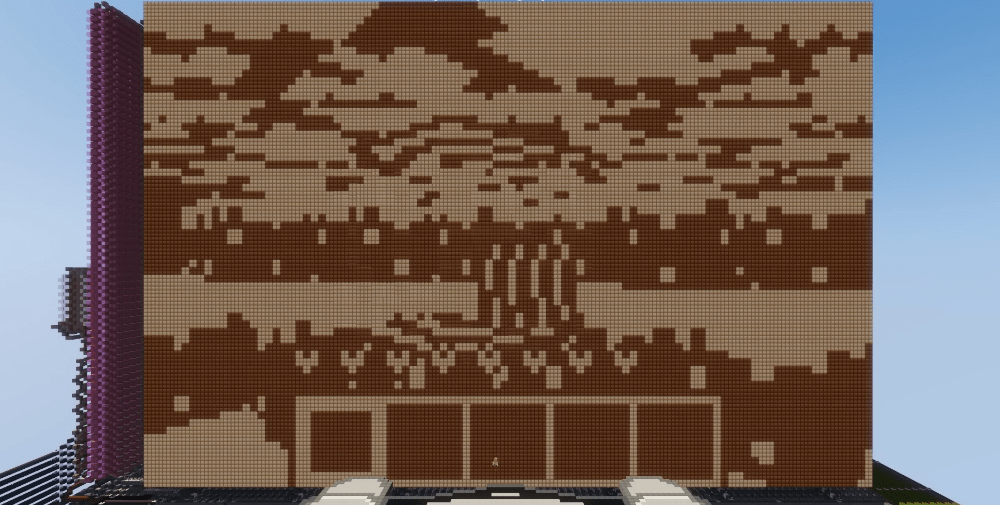
An Engineering Marvel: How Does It Work?
For the average player, redstone — is a way to open a door with the press of a button. For redstone engineers — it’s the equivalent of electrical circuits and binary code. The "Minecraft Inside Minecraft" project (often associated with the work of YouTuber Sammyuri and his team, who created the CHUNGUS 2 processor) is a colossal structure made up of millions of blocks.
This computer does not use command blocks (which are essentially cheat codes for programming). It operates on "pure" redstone, using the game’s physics to transmit signals.
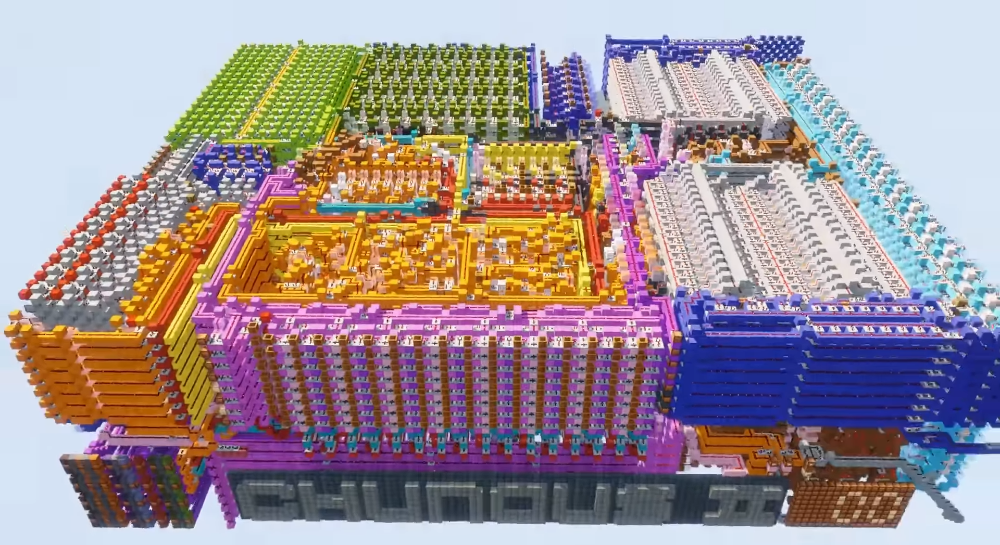
- Processor: The heart of the system is a massive array of logic gates (AND, OR, NOT) that process data. The frequency of such a processor is measured not in gigahertz but in hertz (or even fractions of a hertz), yet its operating principle is identical to real CPUs from the 1980s.
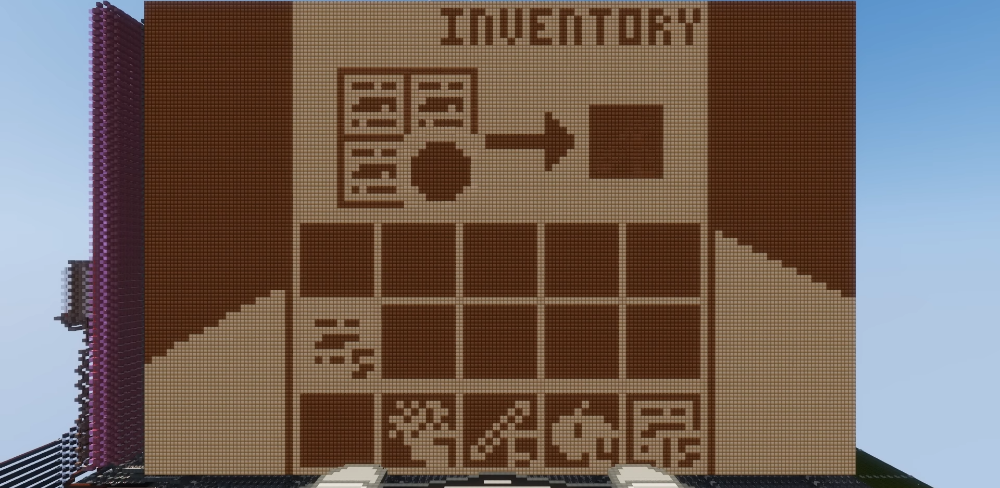
- Display: The screen is a matrix of redstone lamps. Each "pixel" is individually controlled and updates in real-time (as much as the game engine allows).
- Controls: The player stands on a special platform with buttons and levers that act as a controller, sending signals to the "system unit."
Technical Challenges and Their Solutions
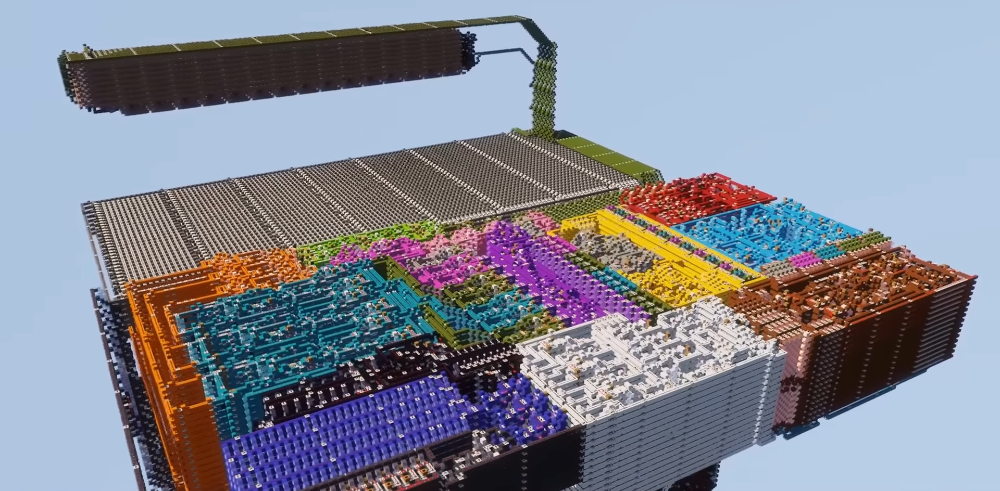
The biggest challenge in creating such a mechanism — is the limitations of the Minecraft engine itself. Redstone works within loaded chunks (sections of the map). If the circuit extends too far, it stops functioning.
To overcome this, the creators had to apply incredible ingenuity:
- Time Acceleration: In real-time, playing on such a computer would run at a speed of one frame every few days. The authors used mods to speed up server ticks, making the gameplay "playable" for demonstration purposes.
- 3D Rendering on a Plane: The most challenging part was teaching the redstone computer to process three-dimensional graphics. The system calculates the position of the player and blocks, then converts this data into a 2D image on the lamp screen, simulating perspective. This is real mathematics implemented with dust blocks and repeaters.
Gameplay: What Can You Do in the "Game Within a Game"?
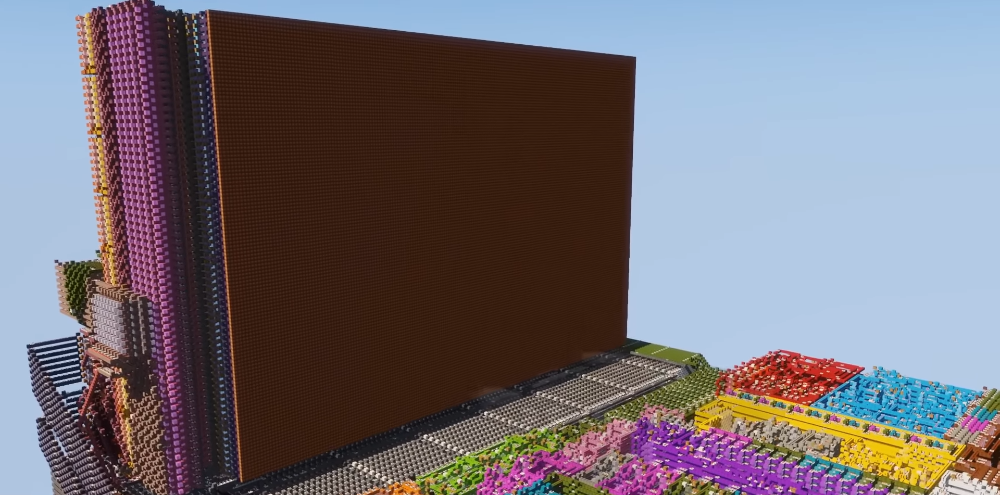
Of course, this isn’t a full version 1.20 with shaders. "Minecraft Inside Minecraft" resembles classic early alpha versions or even simplified clones like Wolfenstein 3D.
The player can:
- Move around a small world (usually 8x8 or 16x16 blocks).
- Break blocks and place new ones.
- See landscape changes in real-time.
- Interact with basic physics (gravity, collisions).
Even such basic functionality requires thousands of operations per second, translated into the language of game ticks. The fact that this works at all without external scripts — is a technical achievement bordering on magic.
Impact on the Minecraft Community
This project — is not just a fun trinket. It demonstrates the endless potential of human creativity and the educational value of Minecraft.
- IT Education: Projects like this visually demonstrate the principles of computer architecture. By analyzing these enthusiasts’ maps, people learn to understand binary logic better than through computer science textbooks.
- New Horizons: It’s a challenge for other creators. If Minecraft can be run, what’s next? DOOM? Windows 95? (Spoiler: attempts are already underway).
Conclusion
The redstone computer running Minecraft — is a monument to the perseverance and intellect of the gaming community. It’s a reminder that the limits of what’s possible exist only until someone decides to break them, armed with a pickaxe and red dust.
Have you tried building complex mechanisms with redstone? What do you think the next big breakthrough in the world of cubic engineering will be? Share your thoughts and experiences in the comments!
- publishedMceadmin
(Google Ads) Privacy Policy and Terms of Use


